Visuomotor policies for multi-fingered dexterous manipulation are
notoriously sensitive to camera viewpoint shifts, typically requiring rigid,
laboratory-grade calibration for successful deployment. Conventional strategies
for achieving viewpoint robustness typically rely on either explicit 3D sensing,
which introduces complex hardware dependencies, or exhaustive data collection
from varied perspectives, which induces significant variance during policy opti
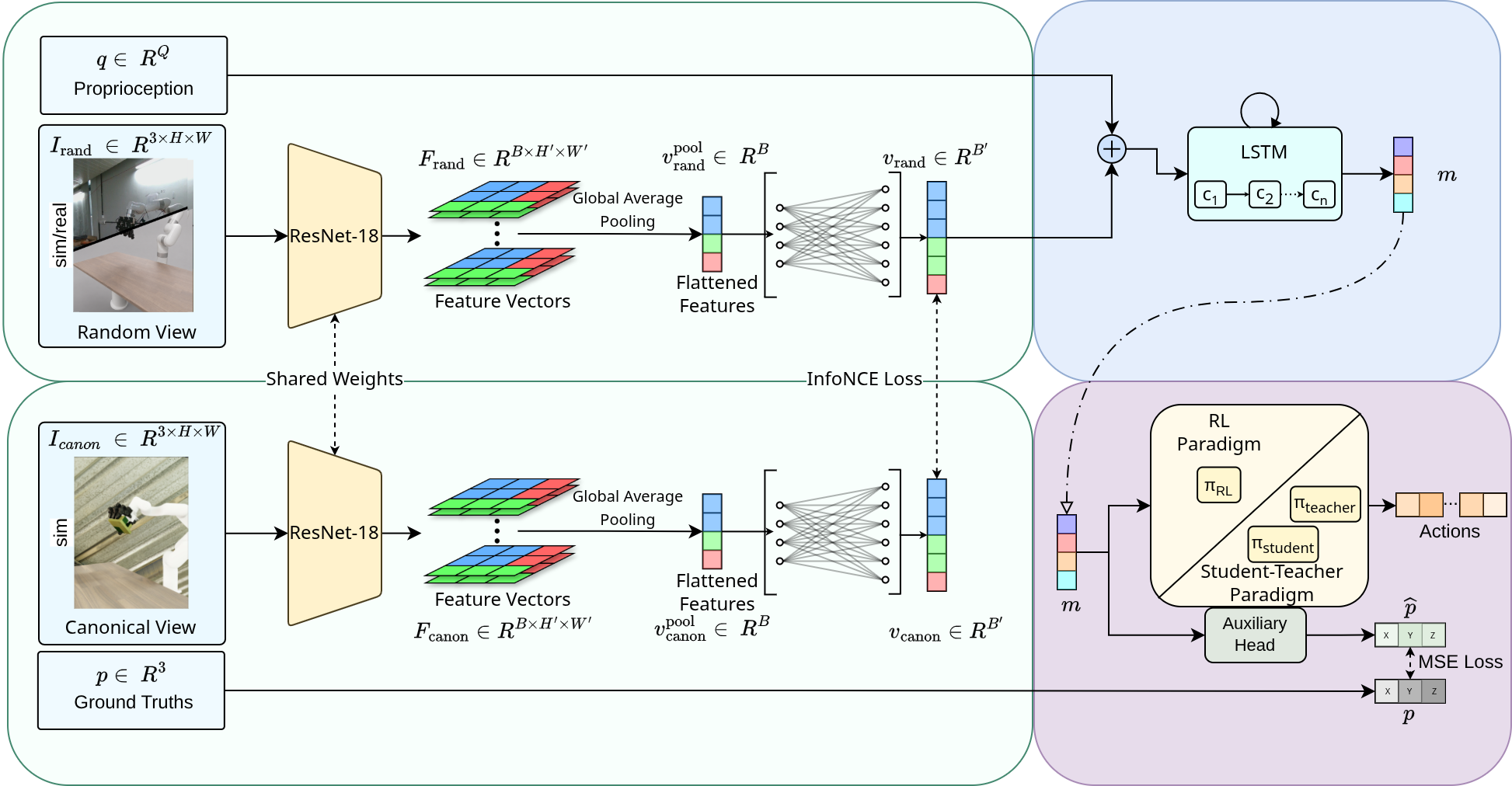
mization. We propose AnyViewDex, a joint representation learning framework
that enables robust, view-invariant dexterous grasping using solely monocular
RGB observations. To resolve the geometric ambiguities of 2D vision with
out relying on test-time depth sensors or prohibitively large multi-view datasets,
AnyViewDex leverages an asymmetric training pipeline. We regularize a stan
dard monocular backbone with auxiliary 3D geometric supervision derived en
tirely from privileged simulation data, anchoring the visual representation in the
physical workspace. This strategy enables the network to implicitly infer the
3D spatial relationships required for dexterity from uncalibrated 2D projections.
We evaluate our framework across reinforcement learning and student-teacher
distillation paradigms, consistently matching the performance of depth-reliant
methods. Finally, we demonstrate zero-shot sim-to-real transfer on a physical
xArm7 equipped with a 16-DoF LEAP Hand, achieving robust multi-object grasp
ing under varying camera perturbations